

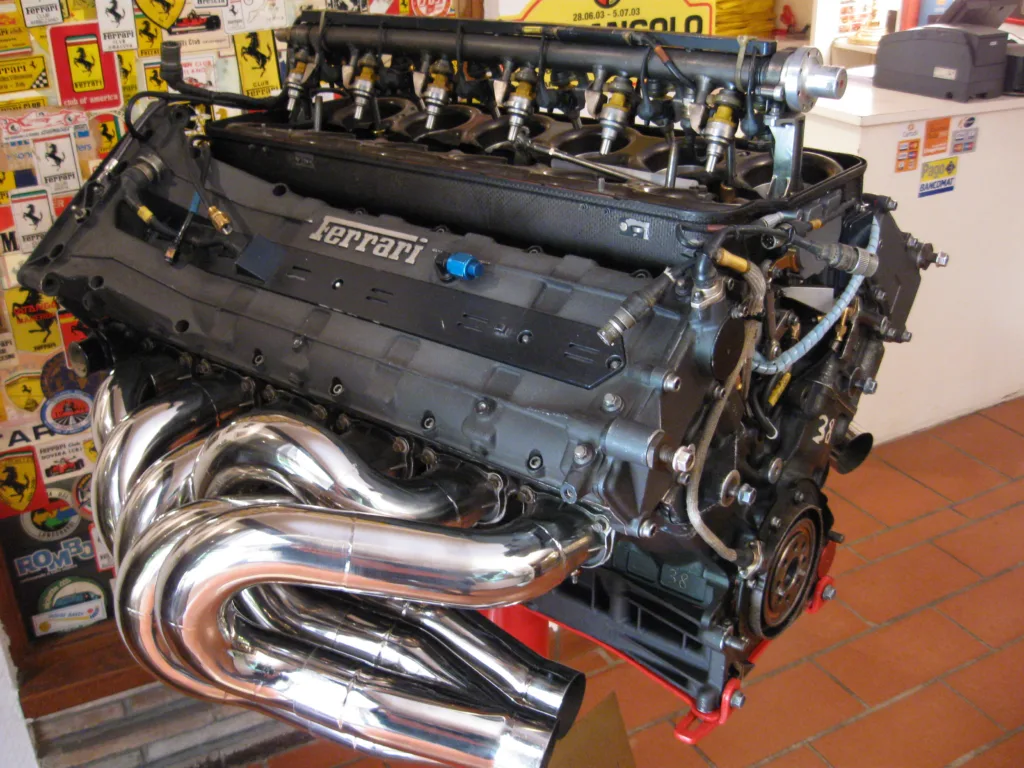
If you were lucky enough to attend a Formula 1 race between 1995 and 2005, you didn’t just hear it. You felt it.
When a V10 Ferrari or a V12 Matra screamed past at 19,000 RPM, it vibrated in your chest cavity. It was a visceral, violent, banshee wail that registered somewhere on the Richter scale. It was the sound of pure, unadulterated horsepower tearing the air apart.
Turn on a race today, and what do you hear? A low drone. A muffled whine. It sounds less like the pinnacle of motorsport and more like my neighbor’s aggressive leaf blower.
Look, I’m a mechanic. I respect engineering. I know the current 1.6L V6 turbo-hybrids are technological marvels. They are brutally efficient. But let’s be real: they have zero soul.
Here is the technical breakdown of why modern F1 has lost its voice.
Key Takeaways: The “Silence” Explained
- The RPM Drop: We went from screaming 20,000 RPM beasts to engines that rarely pass 12,000 RPM.
- The Turbo Effect: The turbocharger sits directly in the exhaust flow, acting as a giant muffler.
- The MGU-H: The hybrid system actively sucks sound energy out of the exhaust to create electricity.
1. It’s Simple Math: RPM = Pitch
Sound is vibration frequency. The faster an engine spins, the higher the pitch of the exhaust note.
In the glory days of the V10s and V12s, engines were spinning at stratospheric speeds—upwards of 20,000 RPM. That is what created that iconic, high-pitched F1 “scream.”
Today’s regulations cap fuel flow so tightly that there is no point revving high. While they are technically allowed to rev to 15k, most drivers short-shift around 11,000 to 12,000 RPM to save fuel and harvest electrical energy.
We lost nearly 8,000 RPM off the top. That’s the difference between a soprano opera singer and a baritone humming in the shower.
2. The Turbocharger is a Muffler
The biggest culprit is forced induction.
A naturally aspirated engine dumps exhaust gas straight out the back, unimpeded. A turbocharged engine forces that exhaust gas through a turbine wheel first to spin a compressor.
Think of it like shouting through a thick blanket. The turbo chops up the sound waves and slows down the exhaust gas velocity before it ever reaches the tailpipe. It’s great for torque; it’s terrible for acoustics.
3. The Hybrid Unit Sucks Up the Noise
It gets worse. Modern F1 cars have something called an MGU-H (Motor Generator Unit – Heat).
This is an electric motor attached to the turbo shaft. Its job is to recover wasted heat energy from the exhaust and turn it into electricity for the battery.
Sound is wasted energy. The MGU-H is literally designed to harvest the energy that used to become noise. The more efficient the hybrid system gets, the quieter the car becomes. They have engineered the emotion right out of the tailpipe.
Miss the Old Days? Join Me in the Garage.
I can’t fix F1 regulations, but I can fix what’s in my shop.
I’m currently tuning a carbureted 350 small block. No turbos, no batteries, just gas and air. It sounds filthy. If you want to hear what a real engine sounds like, come hang out while I dial it in.
FAQ: F1 Engines
Will V10s or V12s ever return to F1? No. The world is moving toward efficiency and road relevance. Manufacturers like Mercedes and Honda use F1 to develop hybrid tech for their road cars. A screaming V12 is irrelevant to modern manufacturing goals.
Are the new F1 cars slower because they are quieter? Actually, no. They are insanely fast—faster around a lap than many V10 era cars. The torque from the electric motors provides instant acceleration out of corners. They are faster, just less dramatic.
What are the 2026 engine regulations? They are dropping the complex MGU-H (the noise sucker mentioned above) and increasing electrical power to 50%. They might get slightly louder, but don’t expect the V10 scream to return.
