
My banker told me last year to put my bonus into a “safe” index fund. He promised me 7% returns if I was lucky.
I ignored him. Instead, I bought a 1978 Rolex Submariner (Ref. 5513).
Today, the market is flat, and that watch is trading for 25% more than I paid.
This isn’t about jewelry. It isn’t about “flexing” on Instagram. This is about Tangible Asset Allocation. Vintage watches—specifically Rolex and Patek Philippe—have outperformed the S&P 500 for the last decade.
They are the ultimate hedge against inflation. They are portable, liquid, and unlike a stock certificate, you can actually enjoy them while they make you money.
Here is why the “Submariner Strategy” is the smartest play you can make this year.
Key Takeaways: The Blue-Chip Rules
- Scarcity is Real: Rolex makes a million watches a year now. But they didn’t in the 70s. The supply of vintage pieces is fixed and shrinking every time someone polishes one.
- Condition is King: An “unpolished” case with sharp edges is worth 50% more than a shiny, rounded one. Scratches are good.
- The “Full Set” Premium: If you have the original box and papers, add 20% to the value instantly.
1. The “5513” Index
If you want to start, don’t buy a weird, obscure model. Buy the “blue chip.”
The Rolex Submariner Ref. 5513 (produced from the early 60s to late 80s) is the Apple Stock of the watch world. It is the classic “No Date” Sub. It is iconic, rugged, and universally liquid. You can walk into a dealer in Tokyo, London, or New York and sell a 5513 for cash in ten minutes. Try doing that with a vintage car.
2. The “Tropical” Mistake
New collectors freak out when they see a dial that has turned brown or cracked.
Pros know that is where the money is.
A black dial that has faded to chocolate brown due to UV exposure is called “Tropical.” It is a manufacturing defect that became a feature. Because it can’t be replicated, these dials command massive premiums. If you find an “ugly” brown Submariner at an estate sale for cheap, buy it immediately. You just paid for your kid’s college.
3. Don’t Polish the Chamfers
This is the number one rule of watch investing.
When you send a vintage watch to Rolex for service, they will offer to “polish it to look like new.” SCREAM NO.
Polishing removes metal. It rounds off the sharp, beveled edges (chamfers) on the lugs. A polished vintage Rolex is a ruined asset. Keep the scratches. They are proof of history.
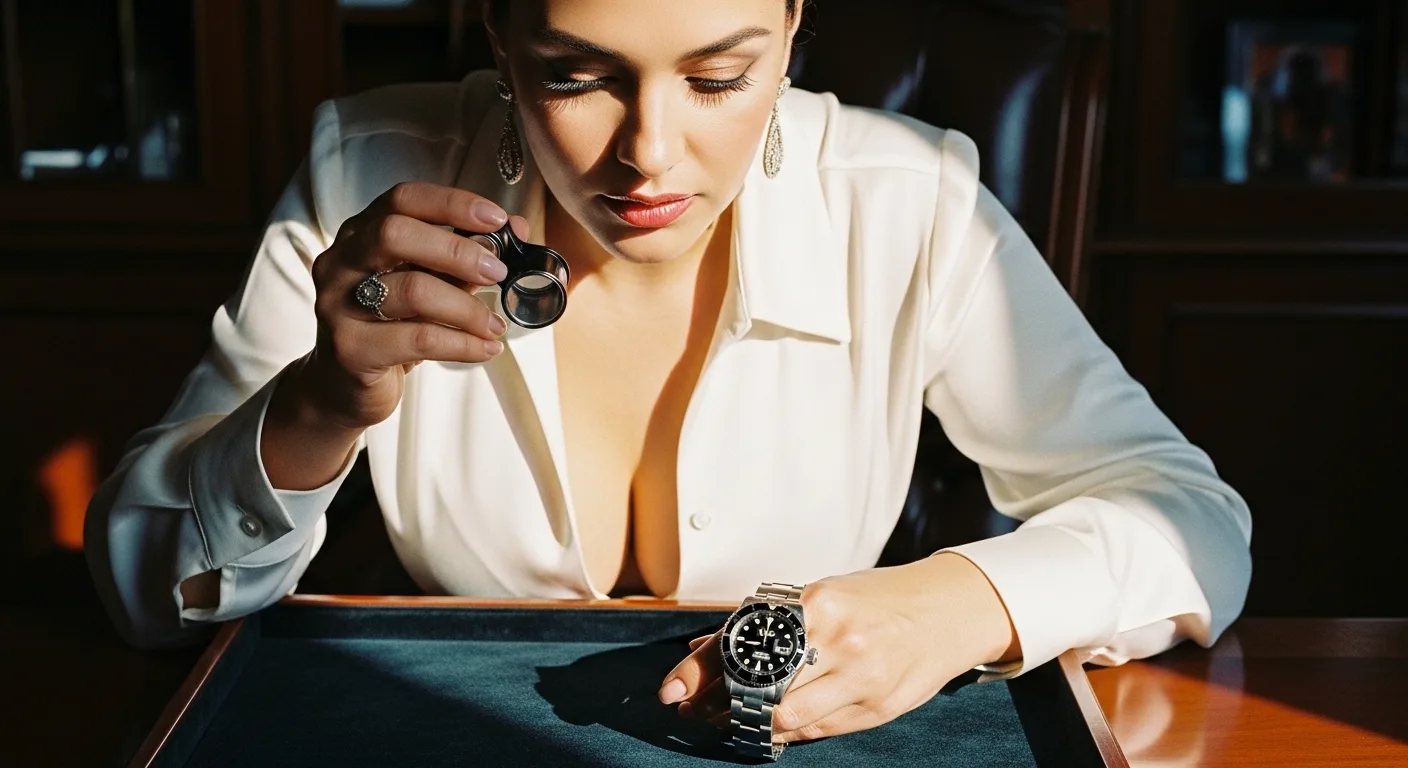
I’m Inspecting a New Acquisition.
A dealer just sent me a “Red” Submariner (Ref. 1680) on approval. The dial looks perfect, but I need to check the serial numbers between the lugs to make sure the case matches the year.
I’ve got the macro lens set up. If you want to see what a $30,000 watch looks like under 10x magnification—or if you want to show me what’s on your wrist—I’m in the office.
[BUTTON: Inspect the Collection with Elena] (Link to your Cam Landing Page)
FAQ: Watch Investing
Is a new Rolex a good investment? Only if you can get it at retail price (MSRP). If you buy a steel Daytona from an authorized dealer for $15,000, it is instantly worth $30,000 on the grey market. But good luck getting on the list.
Should I wear my investment? Yes. Watches are mechanical; they need to move to keep the oils inside from drying out. Just don’t wear it while operating a jackhammer.
What about Omega? The Omega Speedmaster (Moonwatch) is a solid hold, especially the pre-1968 models with the Caliber 321 movement. They are stable, but they don’t appreciate as aggressively as Rolex.
