
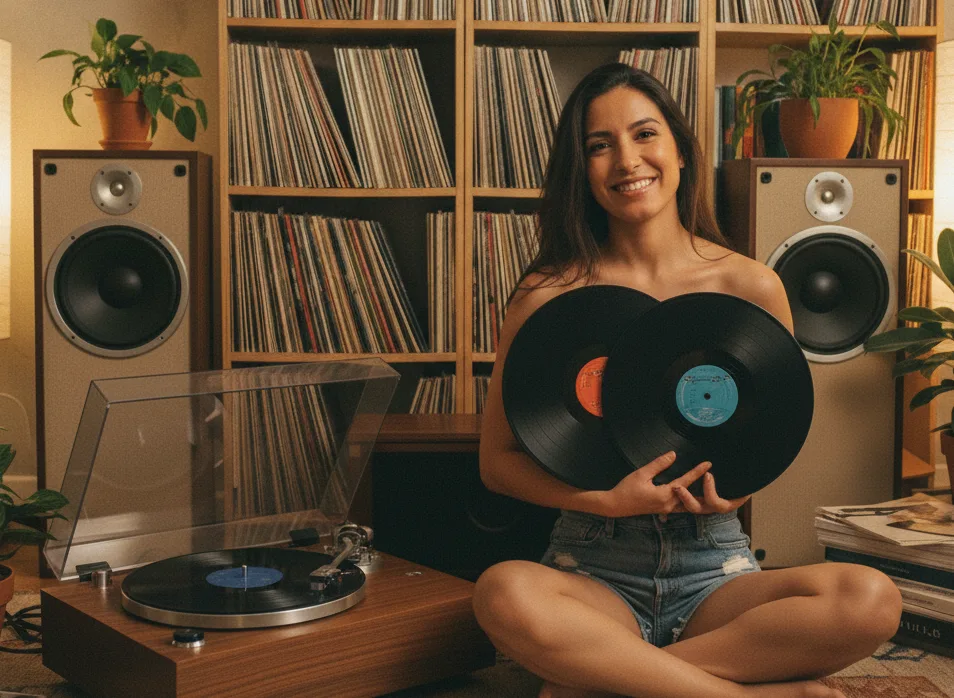
Digital music is for commuting. It is background noise. You put on a Spotify playlist and forget it exists while you answer emails.
Vinyl is different. Vinyl is an event.
When you pull a record from the sleeve, brush off the dust, and drop the needle, you are making a commitment to sit down and listen for 20 minutes. It forces you to slow down. It demands a drink. It demands your attention.
The problem is the “Audiophile Tax.” You can easily spend $50,000 on a hi-fi system, but you don’t have to. You can get 90% of the magic for under $1,000 if you know where to put your money.
Here is how to build a setup that looks beautiful, sounds warm, and doesn’t require a second mortgage.
Key Takeaways: The Hi-Fi Rules
- The “Crosley” Rule: Never, ever buy those all-in-one suitcase players. The heavy tracking force will chew up your records in ten plays.
- Speakers First: Your speakers affect the sound more than anything else. Spend 50% of your budget here.
- Belt Drive vs. Direct Drive: For listening (not DJing), you want a Belt Drive. It isolates the motor vibration from the needle.
1. The Turntable: Pro-Ject Debut Carbon Evo ($600)
This is the gold standard for entry-level audiophiles. It is minimalist, beautiful, and built like a tank in Europe.
Why this one? It comes with a carbon fiber tonearm (usually found on $2,000 tables) and a pre-mounted Ortofon 2M Red cartridge. It extracts detail from the grooves that you didn’t even know was there. Plus, it looks like a piece of modern art on your credenza.
2. The Speakers: Kanto YU6 ($450)
If you don’t want to mess around with buying a separate amplifier and a tangle of wires, get “Active” speakers.
The Kanto YU6s have a built-in phono preamp (which saves you another $150). You just plug the turntable directly into the speakers. They have Kevlar drivers that produce a punchy, warm sound that fills a medium-sized room perfectly. They look sleek, and they get loud without distorting.
3. The “Ritual” Accessories ($50)
You need two things to keep your records alive:
- A Carbon Fiber Brush: Use this every single time before you drop the needle. It removes the static and dust that causes pops and clicks.
- Inner Sleeves: Throw away the paper sleeves the record came in (they scratch the vinyl). Buy “MoFi” anti-static sleeves.
I’m Spinning Miles Davis.
I just picked up a copy of Kind of Blue on 180-gram vinyl. The trumpet on “So What” sounds like he is standing right in front of me.
I’m pouring a glass of wine and listening to Side A. If you want to hear what a real system sounds like (or just hang out while the record spins), the room is open.
[BUTTON: Listen with Elena Live] (Link to your Cam Landing Page)
FAQ: Vinyl Setup
Does vinyl actually sound better than digital? Technically, digital has a wider dynamic range. But vinyl is “lossless” analog. It captures the warmth and imperfections of the original recording session. Digital sounds clean; vinyl sounds live.
What if I have old records from the 70s? Play them! A good cleaning usually brings them back to life. The pops and crackles are part of the charm—we call it “surface noise.” It adds texture.
Do I need a subwoofer? For jazz and classic rock? No. A good pair of bookshelf speakers handles the bass just fine. If you listen to hip-hop or movies, maybe add one later.
